|
| Happy Birthday Communist Party! |
 |
| Ming Dynasty Barbie and Ken - this is new since our last visit |
If you were hoping to see China someday then I have some bad news for you: it’s too late. Everyone knows about the phenomenal growth that China has been experiencing in the last several years. What you have not seen on 60 Minutes or Dateline is that all that money flowing into China has created a middle class, and they go on vacation. In a way that’s great. Just as in the US we want people to go to the Smithsonian and the National Parks and to generally enjoy the nation’s cultural and natural heritage, the Chinese government seems to be pushing that too. Unfortunately, China, big as it is, has very little natural space set aside. Much of its cultural heritage was destroyed in the Cultural Revolution so you have many, many Chinese flocking to see relatively few things. The result is that at sites like the Forbidden City you have a sea of tour guides carrying little flags for a busload of people all wearing the same bright orange visor to follow. Now imagine 3000 such groups, all of them flowing past the same 5 things that everyone else, including you, came to see. Your kindergarten teacher told miserable lies – sharing isn’t great.
 |
| Pooh with the Chairman |
Next, the Chinese are in serious need of a crying Indian/ Woodsy the Owl anti-littering campaign. We watched a young woman on the Great Wall wipe grime off her shoes with a napkin and then throw the soiled tissue over the side, while standing 2 feet from a trash can. Why not? Everyone else was lobbing plastic bottles, snack wrappers and indeed whole ramen bowls off the walls. This utter lack of respect for cleanliness or for preserving cultural relics by not touching/scratching/climbing/spitting on them was alarmingly rampant. At the Forbidden City we watched person after person put their hands on the huge bronze basins that were kept full of water to fight fires back in the Emperor’s day, right in front of a sign telling people not to touch the relic. (To be fair, we could only read the English on the sign. It is possible that it told the Chinese to touch all they wanted since the laowai were not allowed to.)Then there are the marble carvings that appear to be melting in a way I can tell you they were not 8 years ago. The bricks in the large courtyards are being pounded to dust under the weight of millions of feet. If it were just the crowds then possibly one could deal. The true horror is the neglect that so many parts of the Forbidden City and the Great Wall are suffering. It is clear that the outer areas of the Forbidden City got a fresh coat of paint for the Olympics. However, beyond those places the deterioration is extreme.
Finally, the sun truly does not shine in Beijing. What passes for sunny skies is a yellowish pall through which the sun is able to cast dim shadows. It is exactly like the post-apocalyptic sky in all those cornball movies. The sky in any case has no definition. You cannot look up and see clouds or blue. It’s a permanent fog. I suppose that we should be glad it’s not worse considering how many more cars are on the road in Beijing now.
On the plus side, there seems to be a lot less substance to the air. My previous recollections were of its utter and absolute un-breathability. The bikes are gone, replaced by thousands of electric scooters and motorcycle carts. Sadly, these drive all over the sidewalks – but we sometimes saw cars doing the same. Understandably, as the traffic is truly horrendous. Other post Olympic improvements include dramatic decreases in smoking and spitting. The signs extolling the “Patriotic Health Campaign” are still here and there and we met some people who told us in the feverish preparations leading up to ’08 the government actually sent texts reminding people not to spit everywhere. There is still a plague of little boys peeing on street corners, but if the Chinese ever embrace the disposable diaper I imagine the Earth could not possibly support the weight of it. The need to water the sidewalks wherever and whenever is rendered slightly confusing as the city now boasts free public toilet facilities every couple 100 meters or so.
All in all, Beijing was not an auspicious beginning to our time in China. When we arrived we immediately got in a fight with our cab driver who took us on an enormous circle tour of the city but eventually to our hotel. That night we managed to find the theater where they do Beijing Opera which was excellent. Kimberly was disappointed that the tables where they used to serve tea and snacks had been replaced by more seating – all obstructed view. We were all disappointed that the Chinese apparently do not know how to sit quietly through a performance. Most of them were just talking in normal conversational tones, but one guy got in an argument with the usher and absolutely refused to shut up for several minutes. (This was the first of several scenes that showed us that there is no longer a sufficient military or police presence in China. Another was at the airport in Shanghai where a guy actually threw one of the x-ray trays at one of the security screeners after screaming and yelling for several minutes and they let him through! Imagine doing that at an American airport.)
Our working theory is that when order has been maintained by a rifle pointed at your head for 90+ years, people aren’t about to follow directions or take anything from other ordinary citizens. There seems to be a real sense of uncertainty about how things are to be handled. No one feels any inclination to do as they’re directed by clerks, sales people or monitors. We have not seen hardly any military anywhere – it makes us somewhat nervous. Where are they? What are they doing? Can they all be censoring online content? Creating World of Warcraft avatars for profit? We thought that was what they used prisoners for. Anyway, we all enjoyed the parts of the performance we could hear. The costumes were particularly fabulous.
 |
| Forbidden City - Hironymus Bosch Edition |
 |
| The dead bird is in a direct line under the handbag |
The next day we went to the Forbidden City which we already described as swarming with tour groups. The amount of pushing and shoving we endured coupled with the depressing shape the place is in made it hard to enjoy it. We had planned to spend the day but after a few hours we were most definitely funned out. The final straw was the museum of ceramics next to the burned out hulk of what was once a beautiful palace now disintegrating practically before your eyes. In the ceramic museum there is perhaps one whole piece. The rest is potsherds that would be discarded as worthless on most archaeological digs. This, however, is all that’s left of a once magnificent collection after the rampaging hordes of the Cultural Revolution were reined in. We walked out through the Imperial Pleasure Garden which is littered with candy and popsicle wrappers. There are people sitting in the gardens scratching their names on the rocks and trampling the plants. The “jade ribbon” canal was choked with trash and a rotting dead bird carcass – which did not keep small children from splashing around in its murky shallows.
We spent the rest of that day trying to buy train tickets to Shanghai and to eat. We had to go to the train station to buy tickets since although they have a ticket office that says they book train tickets, the Sha Tan Hotel does not in fact book train tickets. That took several hours because, though there are 80 or more ticket windows at Beijing South Station, only 2 (literally) are open - this despite the fact that there are two hundred people in each line. I guess 400 people in a city of 13 million is not that many. Anyway, next we went looking for a Papa John’s pizza (yes, bribing the child) that the internet claimed existed. This turned out to be false, though in China things that are planned are treated as if they already exist. On our way back to our hotel we were pleased to find a place called Grandma’s Kitchen “American Home Cooking” and it sure was. We had a wonderfully restorative dinner and headed back to prepare for our trip to the Great Wall.
We booked the standard tour to the Wall because we had found that getting around Beijing is far too great a pain so we paid for the convenience of being ferried around. The problem with this tour is that it takes you to several “museums” which are really shops. We were treated to the jade, silk, pearl, and tea museums. The tea place was actually pretty good. The woman told us about the different teas, how they should be prepared etc. and we got to drink the tea. The others were just awful; five minutes of interesting information and 40 minutes of standing around with people trying to talk you into buying something.
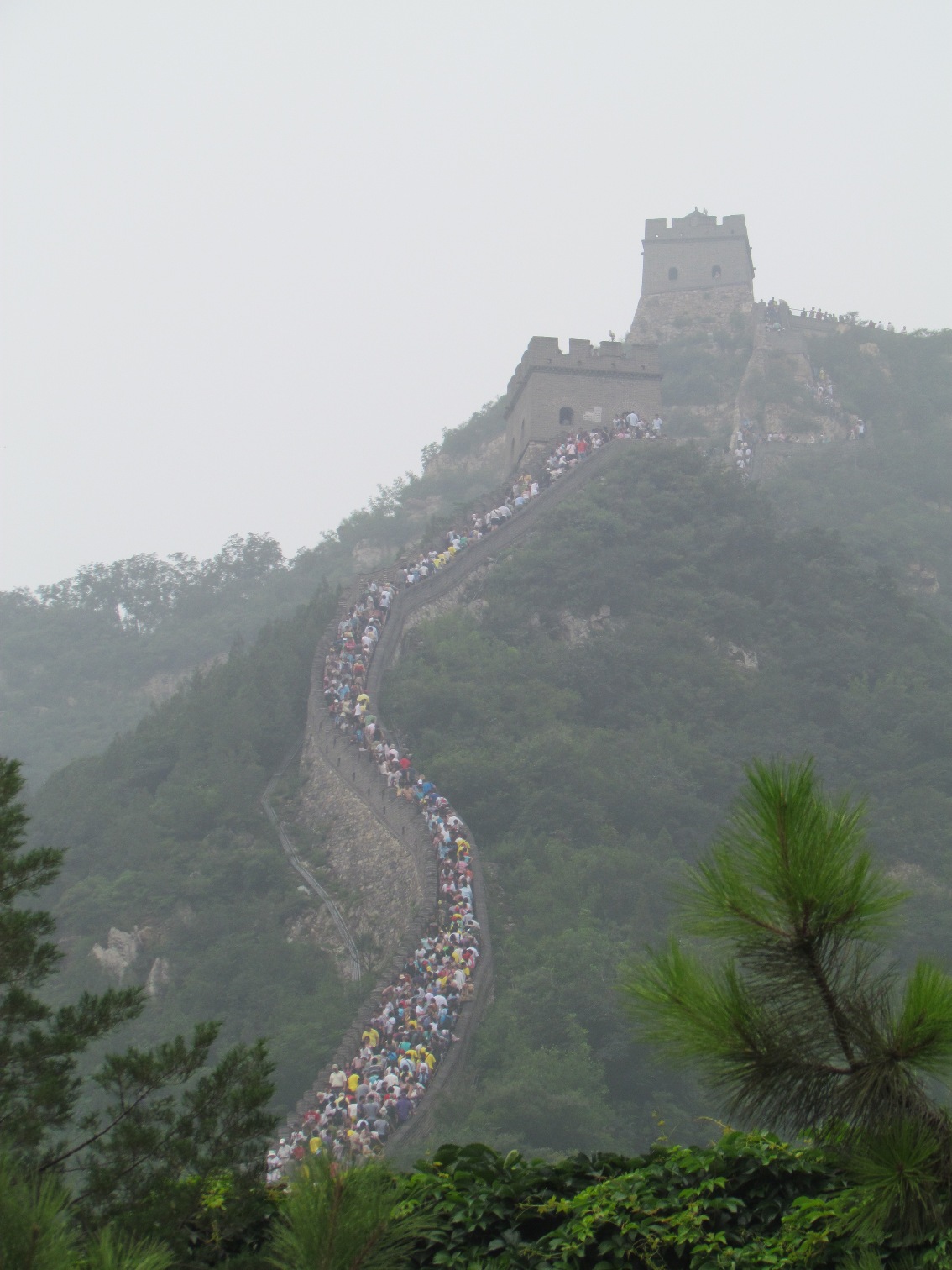
The Wall, like the Forbidden City, is awash in Chinese tour groups. From the base looking up all you can see is a brightly colored river of humanity snaking up the mountainside. Climbing up was like being a salmon swimming upstream including the part about wanting to die at the end. The Great Wall was covered by the Great Pall so it was difficult to see very far. The higher was climbed the worse the view got. We abandoned our attempt to get to the top of the section because of the depression brought on by the state of the Wall. Also, knowing that we would be fighting against the tide of sweaty people going up, we’d never make it down in time.
 |
| Built to Protect China From the Mongol Horde - the Han horde is too much for it |
Another distraction we began facing in China was the tremendous number of people who wanted our picture or wanted their picture or their child’s picture taken with Zada. This did not happen to us in Mongolia but in China everyone seems to want a photo of the wily and elusive person of European descent. On the street in Beijing a few people stopped dead in their tracks and started snapping away like we were celebrities or pandas strolling across Tiananmen Square. Poor Zada must have had her picture taken 10 times or more on the wall. She played along well doing her part to make the Chinese think that Americans are friendly people. What is this about? Our kind were everywhere, surely the fascination should have worn off by now. We are often unique when travelling because of Zada; not this year. We have seen countless intrepid/deranged families towing flotillas of small children all over China. Anyhow, that takes up a bit of time as well. The people who ask are much less funny than those who hunker down and try to get all “wild kingdom” – surreptitiously photographing Zada.
 |
| Marxism - A Thriving Economic System |
After the rugby scrum at the Wall were taken to the Ming Tombs. Kimberly was there about 14 years ago when it was basically a bunch of ruins and holes in the ground, everything having been despoiled during the Cultural Revolution. At that time they said as much. Now, the site is rebuilt, and the guides do not say that everything was destroyed but that “excavations are ongoing” or “that area is not open to visitors for its protection”. This is representative of the revisionist view of history that most Chinese seem to have. On every street corner there is someone hawking Chairman Mao watches/ tote bags/ key chains etc. I figured that that stuff was for the tourists but the long lines to visit Mao’s mausoleum show that they’re still in love with that nut and think that everything they have today is the result of his forward thinking (sic) policies.
Overall, our time in Beijing was a disappointment. Although it was a little amusing to see them fetishizing their own traditional culture, it was mostly sad to see the Chinese gawking at the shattered remnants of their once great civilization. It is striking when compared with Russia which went through much of the same upheaval in the 20th century. In Russia, they have such respect for their heritage and patrimony that much of the treasure of the Czars has been preserved (or, to be fair, wrested from every corner of their empire – we did see many “gifts” from the people of Armenia, Ukraine, Tajikistan and the like). Meanwhile, in China, they were actively destroying anything that predated the advent of the Chinese Communist Party. I wonder if it hurts them deep down that people the world over come to see the China of 2000 years ago and there’s so little left that they have had to fake it up, or show pottery fragments like they’re some great achievement.
 |
| A View of The Forbidden City - Sans Tour Groups |
This is all very negative – to reinforce the positives: the Chinese are getting to enjoy their own country, the streets/sidewalks are much enlarged, cleaner and repaved, the subway system is totally redone and is a thing of beauty. In five more years it will be a totally different scene. They will be forced to embrace online booking and develop some sort of real system to manage these tourist sites or they will be ground into dust.


 That first evening in Shanghai we walked along the waterfront to admire its collection of colonial architecture. It’s a mash up of neo-classical, art nouveau, and gothic buildings. This area is called the Bund and it’s where all the European merchants set up shop in the 19th century. As the sun went down we saw that at night Shanghai is lit up like the Strip in Vegas. Every skyscraper has lights flashing up and down its sides. There was more than one building that had stock market updates and advertizing 50 stories high on all sides. We walked over to Nanjing Road which is like a Chinese Times Square for dinner and dessert and then back to our hotel.
 The next day we went back to the Bund and had breakfast in a café while we decided what to do. We settled on the Yuyuan Gardens. They were first built in the late 16th century by a wealthy Ming Dynasty official and, though roughed up a few times during the Taiping Rebellion and World War 2, look wonderful. To get to them however you must brave a bazaar of unbelievable greatness. The problem with shopping in China is that you cannot be “just looking”. If you even slowdown to look at something in a shop the proprietor will swoop down on you and attempt to make you buy it. There were many amazing things to see but we soldiered on through the shops and found the entrance to the gardens, across from a Starbucks! Shanghai’s weather is such that it calls to mind Houston in late April so we were glad to get a cool drink before heading into the tranquil gardens. The garden was indeed quite wonderful. Narrow path wound here and there through forests drooping pine trees and bizarrely weathered rocks to pavilions with delicately carved window panels and brightly painted walls and ceilings. There were pools teeming with fish and turtles with little bridges across. Another thing about Shanghai is that relative to Beijing, the air is pristine and completely breathable so walking around was quite pleasant.